Air column bags don’t protect products by magic. They protect only when the film, the valve, the inflation, and the box all work together. Over the times, PackBest Air Packaging have noticed the same handful of questions coming up again and again from brands, 3C factories, wine distributors and cross-border sellers: why do bags go flat, why do columns burst, how thick should the film be, and how do I actually cut my damage rate instead of just my packaging cost?
Let’s go through them one by one.
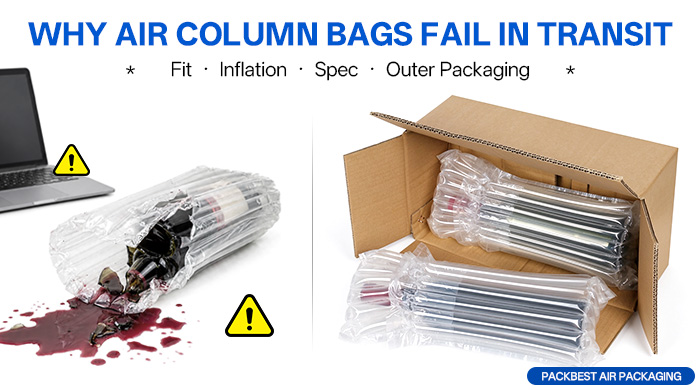
- Why Do Products Still Get Damaged with Air Column Bags?
Air column bags are designed to cushion products against impacts during transportation. But even a well-made air cushion bag can underperform if it’s the wrong size, structure, or specification for the product.
Common causes include:
– Poor fit: An air column bag that’s too large allows the product to move around inside the packaging. One that’s too tight may put unnecessary pressure on the product or its vulnerable parts.
– Insufficient cushioning: Products with sharp edges, heavy components, or delicate surfaces may require a different material structure or protective design, such as PackBest TV hanging air column bag.
– Incorrect inflation: Underinflated cushions may not provide enough support, while excessive inflation can increase stress on the packaging and affect its performance.
– Inadequate outer packaging: Air column bags are protective cushioning, not a substitute for a suitable shipping carton. The box must also withstand stacking, handling, and transportation conditions.
Before switching materials or adding more layers, ask yourself: Is the packaging actually designed for the product I’m shipping?
- How Do You Choose the Right Air Column Bag Size?
A common purchasing mistake is choosing packaging based only on the product’s length, width, and height.
The better approach is to consider the product’s shape, weight, fragile areas, and how it will be packed.
For example: Wine bottles and glass containers
A bottle-shaped air column bag can provide cushioning around the body and help protect vulnerable areas during handling. Check that the bag fits the bottle securely and that the neck and base receive appropriate protection. In addition, PackBest considers the convenience of your packing process, offering a range of air column bag designs to suit different needs—from single-bottle and multi-bottle bags to custom air column bags designed for bottles packed in cartons.
Electronics and appliances
Products such as laptops, monitors, and small appliances may need U-shaped, L-shaped, or other customized air column structures. Consider corners, screens, protruding components, and the space between the product and the outer carton. Here, we recommend exploring our comprehensive TV air column bag solutions. You’ll find inspiration for packaging TVs of different sizes and designs, as well as LED screens and other similar electronic products.
Irregularly shaped products
For products with unusual contours, a standard air column bag may leave gaps or create pressure points. A customized structure can help provide a closer fit and more consistent positioning.
The goal is to make the protective structure work with the product.
- How Thick Should an Air Column Bag Be?
This is one of the most important questions for packaging buyers.
A thicker film may offer improved resistance to punctures or demanding handling conditions, but thickness alone does not determine cushioning performance.
A practical tip: Don’t ask your supplier only for the thickest film available. Explain what you’re shipping, how heavy it is, and what damage you’ve experienced.
A packaging supplier should help you evaluate the complete specification rather than relying on a single thickness number.
- How Can You Reduce Packaging Costs Without Sacrificing Protection?
If your current packaging requires excessive bubble wrap, foam, tape, or oversized cartons, it’s worth reviewing your packing process.
Air column bags arrive flat before inflation, which can help reduce the storage space required for uninflated packaging materials.
But the real cost-saving opportunity goes beyond storage. Consider these questions:
– Can your team replace multiple manual wrapping steps with a more consistent protective structure?
– Can a better-fitting bag reduce unnecessary void fill?
– Can the right carton size reduce wasted space without compromising protection?
– Can standardized packaging specifications help new employees pack more consistently?
A better way to evaluate cost is to look at the “total cost per successfully delivered product”, including material consumption, packing labor, storage, shipping, and damage-related expenses.
Looking for a Better-Fitting Air Column Bag?
At PackBest Air Packaging, we understand that different products require different levels and types of protection. That’s why choosing air column packaging shouldn’t be a one-size-fits-all decision.
Whether you’re shipping bottles, electronics, appliances, or other fragile products, we can help you explore suitable air column bag structures, sizes, and material specifications based on your packaging requirements.
Share your requirements with PackBest Air Packaging, and let’s find a smarter way to protect your products while making your packing process more efficient.