If you’ve ever unloaded a sea container only to find pallets shifted, boxes crushed, and fragile inventory damaged mid-voyage, you’ve probably asked this exact question: Are dunnage bags actually reliable for ocean freight?
We hear the doubt all the time. Many importers and brand owners write dunnage bags off as “too risky” — and honestly, it’s easy to see why. A cheap, thin off-spec air dunnage bag can rupture under the constant vibration, rolling and pressure shifts of cross-ocean transit. When that happens, cargo slides, stacks collapse, and you’re stuck with damaged goods, delayed orders and an uphill battle for insurance claims. More often than not, your freight forwarder won’t cover those losses.
But here’s the truth: The problem is not the dunnage bag itself. It’s choosing the wrong one for the job. Let’s walk through what you need to know to pick, measure and load them the right way.
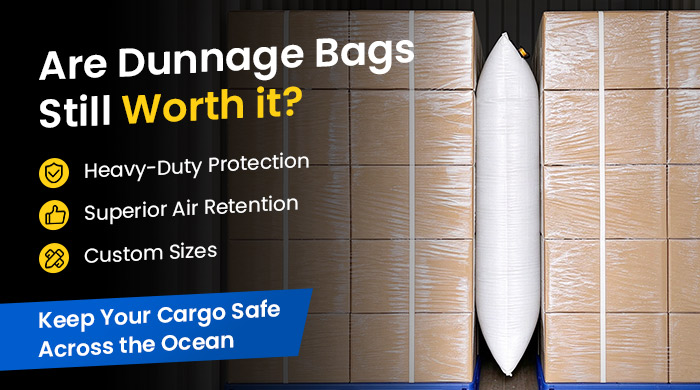
The PackBest Solution: Engineered for Heavy-Duty Ocean Freight
At PackBest Air Packaging, we don’t just sell bags; we engineer cargo stabilization solutions. Our heavy-duty container air dunnage bags are designed specifically to combat the harsh realities of ocean freight.
Why do global brands trust PackBest?
Multi-Layer Protection: We use high-quality, multi-layer co-extruded PA (Nylon) + PE inner films. This ensures superior air retention and puncture resistance, preventing the slow leaks that ruin shipments.
Heavy-Duty Outer Layers: Choose from our Kraft Paper (eco-friendly, high friction, great for printing) or PP Woven (ultra-durable, moisture-resistant, reusable) outer layers, depending on your specific cargo needs.
Built to Hold: Our air dunnage bags are rigorously tested to withstand massive compressive forces (capable of supporting loads from 1,500kg up to over 10,000kg depending on the model), keeping your pallets upright and secure.
Customization is Key: From standard sizes to custom dimensions and specialized quick-release valves, we tailor our air dunnage bags to fit your exact container and cargo gaps.
Pro-Tips: How to Choose and Use Air Dunnage Bags Like a Pro
Even the best air dunnage bag in the world won’t work if used incorrectly. Here is our quick guide to getting the most out of your dunnage bags:
- Measure the Gap, Not Just the Height
Measure the exact void space between your pallets or between the cargo and the container wall.
Rule of Thumb: The inflated thickness of the air dunnage bag should be slightly larger than the gap it needs to fill (usually by about 10-20%) to ensure a tight, friction-based lock.
- Match the Air Dunnage Bag to the Cargo
Kraft Paper Bags: Ideal for smooth, uniform boxes and pallets. The paper surface provides excellent friction.
PP Woven Bags: Best for heavy machinery, irregular loads, or environments where moisture might be an issue.
- The 80% Inflation Rule
Never inflate the air dunnage bag until it is completely rigid. Stop at about 80% inflation. The bag should feel firm but still have a slight “give” or bounce when pressed. This allows the air inside to expand safely during temperature fluctuations without bursting the bag.
- Protect Against Sharp Edges
If your cargo has sharp corners (like wooden crates or metal strapping), place a piece of corrugated cardboard between the cargo and the dunnage bag to prevent punctures.
Stop the Bleeding: Secure Your Supply Chain Today
Every damaged shipment costs you more than just the product—it costs you customer trust, reputation, and endless hours of dispute resolution with freight forwarders.
Don’t let a $5 cheap bag cost you a $50,000 shipment.
Ready to eliminate cargo shift and collapse?
Contact PackBest Air Packaging today. Tell us your container type, cargo weight, and gap sizes, and our engineering team will recommend the exact air dunnage bag configuration to keep your ocean shipments safe, secure, and compliant.