You just landed a big order from an overseas buyer, and the products you spent months developing are ready to ship. They’re fragile — glass bottles, delicate electronics, or maybe oddly shaped ceramics. You’ve already lost too many packages to bubble wrap that crushed flat or foam inserts that take up half your warehouse. Now you’re staring at a wall of air column bag options online, wondering: *Q-type or L-type? 20-micron or 50?
The good news is that choosing the right air column bag isn’t complicated once you know what to look for.
Step 1: Match the Shape to Your Product’s Silhouette
Let’s start with the most visible factor: bag shape. PackBest air column bags come in several distinct types, each designed for a specific kind of product. Picking the wrong shape—the product will shift, and the protection will fail.
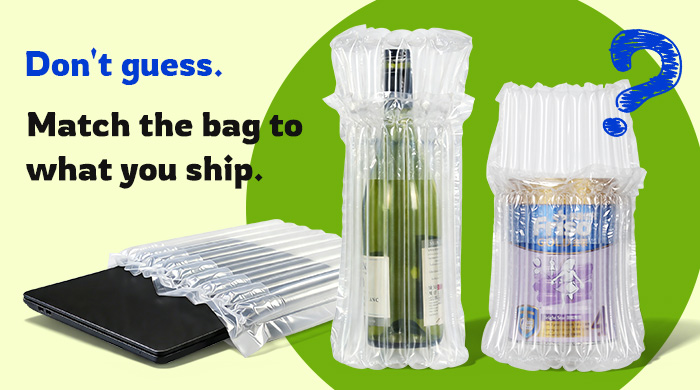
Q-type air column bags (360° wrap): These form a closed loop around the item — think of it as a “protective hug.” If you’re shipping wine bottles, cosmetics, perfume, or any fully enclosed glass item, this is your go-to. Q-bags leave no surface exposed, eliminating what we call “dead zones” where impacts can sneak through.
L-type air column bags (flap closure): The L shape features a taller side that folds over and seals the opening with tape. They’re ideal for products with wider bottoms or larger diameters — milk powder tins, canned goods, tea boxes, or large jars. The wide mouth makes packing significantly faster than Q-bags.
U-type air column bags (open-top cradle): As the name suggests, this is a U-shaped bag without a lid. It’s purpose-built for flat, oversized items like monitors, TVs, framed artwork, or large photo prints. You simply slide the item in — no folding, no fuss.
Corner protectors: Not a full bag, but essential for protecting vulnerable edges and corners of furniture, screens, or industrial equipment.
Air column rolls (on-demand cut): Perfect for highly variable product sizes or irregular shapes. You cut what you need, inflate, and wrap — no waste. Many fulfillment centers use rolls as dunnage or top/bottom padding.
Still unsure about your product’s shape profile? Ask us directly — we’ll match you with the right design in minutes.
Step 2: Let Product Weight Guide Your Thickness and Column Count
This is where many merchants make a costly mistake — choosing film thickness based on price rather than protection requirements. An air column bag with a single-layer thickness of 30 microns may be fine for a small tube of hand cream, but it’ll likely burst under the weight of a 750ml wine bottle.
Film thickness typically ranges from 25 microns to 120 microns for single layer, with 50mirons–60 mirons being the industry standard for most general-purpose applications. For heavier items or long-distance shipping, we recommend 70mirons–100mirons. At PackBest, we use high-performance 7-layer Nylon + PE co-extruded film, which provides excellent puncture resistance and airtightness.
Column count works hand-in-hand with thickness. Simply put, “columns” refer to the number of independent air chambers running side-by-side in a single bag. More columns mean stronger load distribution and better shock absorption.
Step 3: The Inflation Factor: Manual vs. Machine
Here’s a decision that impacts your daily operations more than you might expect.
Manual inflation (hand pump or air compressor) works beautifully for:
Low to medium volume operations
Variable product sizes
Businesses needing maximum flexibility
Automatic air cushion machines become essential when:
You’re processing hundreds of packages daily
Consistency is critical (no under or over-inflation)
Peak seasons create bottlenecks
PackBest air column bags integrate seamlessly with standard air cushion machines, inflating in seconds without specialized equipment. For high-volume operations, this can cut packing time by 50% compared to traditional wrapping methods.
Step 4: Learn From Real-World Applications
Need some concrete examples? Here’s how PackBest has helped merchants like you:
Electronics: A mobile phone accessory brand uses air column bags with black film for privacy and a non-inflatable header for direct labeling — clean, professional, and fully protected.
Wine & Spirits: A vineyard shipping internationally uses Q-shape air column bags for single bottles and six-pack air column bag for boxed wine. The snug fit prevents bottle-to-bottle contact.
Furniture: An office chair manufacturer uses U- shape air column bags with 6cm-wide columns for heavy-duty cushioning, plus a separate non-inflatable compartment for assembly accessories — nothing gets lost in transit.
Still not sure which configuration fits your product? Don’t gamble with your shipments. Send us your product details, and our experts will help you select the perfect air column bag solution — whether it’s Q-bags, L-bags, custom-printed, or something entirely unique to your needs.